

Caste is an entrenched social reality, and it has transformed into a new avatar on various social media platforms. Social scientists must also study this phenomenon and how it persists today despite advancements in technology and globalisation.
The uneven access to the internet along caste lines exacerbates these inequalities, with upper-caste dominance evident in both online media representation and social media usage (Sapra, 2020). Despite the promise of social media as a platform for marginalised voices, the reality is far more complex. While it has facilitated community-building and activism among lower-caste individuals, it also replicates and reinforces existing hierarchies, perpetuating the exclusion of marginalised communities (Sapra, 2020). Thus, addressing caste-based hate speech online requires a multifaceted approach that includes legal reforms, platform accountability, and critical anti-caste perspectives in digital spaces.
Understanding the extent of internet usage in India helps contextualise the impact of digital caste dynamics. As of March 2023, India had 881.25 million internet subscribers, making it the second-largest online market globally (Telecom Regulatory Authority of India, 2023). Despite this vast number, internet penetration remains just under 50%, below the global average. Projections indicate India's internet users will grow to over 1.6 billion by 2050 (International Data Corporation, 2023). Rural areas account for 442 million users, with Andhra Pradesh leading with 53.80 million users (Internet and Mobile Association of India, 2023). Social media usage in India is significant, with 33.4% penetration and platforms like Facebook, Instagram, WhatsApp, and YouTube being highly popular (Digital 2023: India report by We Are Social and Hootsuite). Despite its size, India's social media market is growing, driven by increasing internet access and 5G adoption. The average Indian spends 7 hours and 19 minutes online daily, with 2 hours and 36 minutes dedicated to social media (Digital 2023: India report by We Are Social and Hootsuite). The ease of anonymity and the rapid spread of misinformation further complicate the dynamics of online discourse, creating fertile ground for the propagation of caste-based prejudices and discrimination.
Given this context, the persistence of caste-based hate speech on social media platforms is a pressing concern. Research reveals disparities in categorisation and identification mechanisms on Facebook and Twitter despite their public commitments to combat hate speech. Facebook includes caste within its protected characteristics in hate speech policies, but inconsistencies in reporting mechanisms raise concerns about efficacy. Internal disclosures unveil a low takedown rate, questioning the platform's effectiveness in curbing hate speech. Twitter faces similar challenges due to limitations in reporting options (Manish Kumar, 2023).
A US research study reveals that approximately 40% of casteist posts on Facebook in India target Dalits and Adivasis. Specific instances of derogatory remarks and hateful content directed at prominent Dalit figures such as Dr. B.R. Ambedkar and Mayawati are highlighted. The study identifies posts demeaning affirmative action policies and perpetuating stereotypes against Dalit individuals, along with instances of doxxing and threats towards activists and journalists (National Herald, 2019).
Through digital ethnography, we have found that there are many types of caste hate speech on social media, including direct caste abuse and indirect caste abuse. A significant portion of casteist posts on Facebook are directed towards Dalits and Adivasis, perpetuating derogatory stereotypes and insults against them, including attacks on their leaders. Instances where posts oppose affirmative action policies with derogatory references to caste-based occupations.The widespread occurrence of doxxing on Facebook, mainly targeting activists and journalists advocating for marginalised communities. Despite reports, many hate speech posts remain on the platform, reflecting a failure in content moderation. Manipulative images and memes aimed at trivialising and demeaning Dalit individuals, particularly women.
Why has it persisted since the entire digital space has monetised where likes and views matter, digital toxicity such as religious caste gender hate, and consensual and non-consensual explicit imagery is profitable; therefore, social media platforms like Facebook, Instagram, X and YouTube flooded with this content. Since it is profitable for everyone, social media platforms and individuals sharing this content ignore the societal norm, and no one is bothered about where society will move and what the implications will be. Politicians often neglect caste-based hate online due to a mix of political expediency and the challenge of regulating vast digital spaces. Addressing these issues might alienate certain voter bases or require significant policy changes, complicating their agendas. Additionally, the sheer scale of content on social media makes enforcement difficult. In some cases, there may be a lack of urgency or awareness about the long-term impacts of caste-based hate.
Conclusion: The persistence of caste dynamics in the digital age underscores the need for urgent attention from both platforms and policymakers to address systemic issues and ensure the safety and dignity of all users, particularly those vulnerable to caste-based discrimination. Social media companies can play a crucial role in combating online casteist hate speech by investing in regional understanding, engaging collaboratively with activists, and providing robust policy implementation. The review advocates urgent action to address caste-based discrimination and emphasises the importance of community-driven approaches to content moderation for fostering safer and more inclusive online environments.
About the author: Dr. Azizur Rahman Azami is an Senior Assistant Professor of Sociology in the department of West Asian Studies at Aligarh Muslim University. With over eight years of experience in teaching and research, he instructs a course titled "Introduction to Digital Society" for international studies students. Over the past year, he has delved into the evolving relationship between technology and social change. Additionally, he presented a paper on online communication in the virtual world at the All India Sociological Society in 2009. His expertise lies in the intersection of social media and societal dynamics, drawing from his background in sociology and comprehensive comprehension of technology's influence on human behaviour. Dr. Azizur brings a multidisciplinary approach to studying digital toxicity in India.
References:
- (Source: Manish Kumar, 2023) "Caste-based hate speech moderation on Facebook (Meta) and Twitter (X)"
- National Herald. (2019, June 24). "40% of India’s casteist Facebook posts are anti-reservation, anti-Dalit reveals a US research"
- Kain, D., Narayan, S., Sarkar, T., & Grover, G. (2021). "Online caste-hate speech: Pervasive discrimination and humiliation on social media".
- Telecom Regulatory Authority of India. (2023). [Telecom Report].
- International Data Corporation. (2023). [IDC Report].
- Internet and Mobile Association of India. (2023). [IAMAI Report].
- We Are Social and Hootsuite. (2023). Digital 2023: [India report].
- Statista. (2023). [Statista Report].

As part of our work on identifying caste based discrimination online, and redefining social media community standards to accommodate caste based abuse, our founder Amitabh Kumar was part of a podcast hosted by Meredith Reed, on behalf of Spectrum Labs. Joining this podcast was Justin Davis, CEO and Founder of Spectrum Labs.
Following is an excerpt from the podcast-
Meredith – What inspired you to work in this field of social media and online safety?
Amitabh - We realized how the world is moving towards technology, and that issues of social injustice are being carried over to the online spaces. Our organization, Social Media Matters, looks into three pillars of online safety- cyber bullying, digital parenting (digital migrants bringing up digital natives) and raising awareness regarding fake news.
Our methodology involves doing research, creating awareness content, and going into the community for conducting workshops. We focus on India, but learn from global players and communities from across the world.
Meredith - Can you tell us a little bit about caste discrimination?
Amitabh - Caste discrimination is the oldest form of social discrimination in India, and many research studies have been conducted to dissect and understand the very nature and complexity of this issue. It is very similar to racism, in that there is a hierarchical caste system, where at the top are the priests and at the bottom are the workers. Then there is a category of people who do not fall under the caste system, and are called "Untouchables". They do menial jobs like cleaning toilets and dealing with dead bodies, which is considered ‘impure’. This thought process of caste discrimination has continued to the online space, since the Indian society has not been able to get over this caste system.
Meredith - What are the legal implications of caste discrimination? What does the government do about it?
Amitabh - The legal frameworks are very strong and in place; the problem is with the implementation.
Meredith - What does this look like in the realm of online spaces? What are the specific challenges?
Amitabh - There are some very active social groups which work on this issue. But the key to understanding this, is that since it has been going on for centuries, many people don't realize that they are being discriminatory. Similarly, people don't realize that they are being discriminated against.
In the online spaces, as per community guidelines, the usage of certain caste names are not permitted, as they are discriminatory in nature.
For tech companies in San Francisco, this issue becomes a challenge because it is quite complex. The scale of this discrimination is huge. If there is a trend or a viral video which is discriminating to certain castes, who do they prosecute?
Meredith - What is Spectrum and Social Media Matters working on together?
Justin – We are coming up with a tool, to be used to identifying instances of caste based discrimination on various online platforms. In order to do this, data has to be analyzed by AI tools. However, before understanding data, it is important to have definitions, and to identify data sets.
Amitabh - A lot of nuanced work has gone into coming up with these definitions, and Spectrum had the tools to incorporate this qualitative data.
Meredith - What are the potential complications in the online space in Text Vs Voice?
Justin – In analyzing text, it’s entire context needs to be understood. One needs to understand whether it was a stand-alone conversation, or part of a larger context and conversation. In terms of voice, there are many other challenges that come into the picture. It is an extensive process, and the technology for transcription of voice to text is still lacking.
Amitabh - Content moderation is a very complex task. Things like humour and sarcasm, require a great deal of understanding of context and culture to transcribe appropriately. A greater level of collaboration is needed between the tech community and those who understand the content. The computer sciences and social sciences need to merge to solve this problem. This is what has happened with our collaboration with Spectrum as well.
What is the end goal of this collaboration? What does it mean for Social Media platforms?
Amitabh - Social media platforms take the formulation of community guidelines seriously, however, it is the implementation which is the problem. Our tool will help them to implement their guidelines better. Our team believes in cyber etiquette and we work towards it in various ways. The aim of this collaboration, is to raise awareness about caste discrimination and our focus is to understand that while technology is a tool, the solution to these problems lies with the users.
Meredith - If more people had access to technology and platforms, would there be a positive change or would it get more toxic?
Amitabh – It is a mix of both. Initially it would get more toxic, but as that increases, greater awareness would also be generated. It is important for platforms to take a strong stance before things get worse.
Meredith- Five years from now, where do you see this technology go? What is your goal with regards to caste discrimination and toxic behaviour in the online spaces?
Justin – The ultimate goal is that the internet becomes an equitable space, and that each person gets the same quality of experience on online platforms.
Amitabh – The process now is that the focus for tech companies is to create the product and then once it becomes a success and the company becomes big, that’s when they start thinking about safety. The true win would be to think of safety on day one of the company’s inception, and to integrate it at the time of product creation. I quote Einstein here, who said “Technology without morals is pointless”. Safety needs to be a systemic part of any tech product, and that needs to be understood.
Thank you Spectrum Labs for hosting this wonderful conversation, and enabling us to elucidate our ideas regarding caste discrimination in the online spaces in a clear manner for everyone!
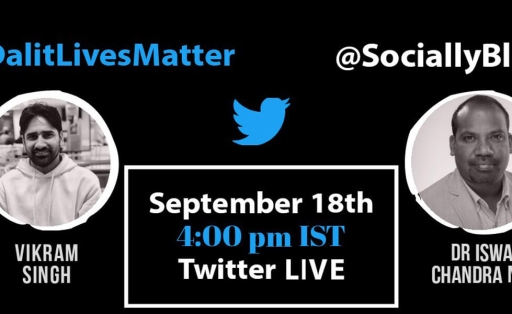
In continuing with our series "Dalit Lives Matter", wherein prevalence of caste based issues on online spaces is discussed with various eminent personalities, Ms Pratishtha Arora engaged in an interesting Twitter Live session with Dr Iswar Chandra Naik, on 18th September 2020.
Dr Naik is an associate professor at Kalinga Institute of Social Sciences (KISS), Bhubaneswar, and has his research interests in tribal movements, Naxalite movements, Dalit movements, and political sociology.
The live session began with Dr Naik narrating incidents from his childhood, wherein he was stopped by an upper caste lady from entering into her kitchen. He discussed how the caste system is very prevalent in the villages, to the extent that Dalits were not permitted to drink water from glasses used by upper caste people. He then proceeded to speak of his journey in higher education, wherein he developed a greater understanding of caste issues, and developed a political bent of mind, towards Dalit issues.
Dr Naik then shared anecdotes of how he decided on his Ph.D topic in Jawaharlal Nehru University, and how he worked on the issues of "Jal, Zameen aur Jungle", related to Adivasi and Dalit rights, and how he is working towards mobilizing Dalits in Orissa, to understand and work towards their rights.
He spoke very highly regarding Mr Achyut Samanta, Member of Parliament, and founder of KISS, which provides free education, residence and meals to Dalits and Adivasi students. He spoke of how despite not belonging to Dalit or Adivasi community, Mr Samanta, empowers many people from these backward communities, and provides them with equal opportunities.
He raises some very pertinent issues regarding providing adequate avenues for Dalits and backward communities to express themselves, and shares how he once got the opportunity to attend a month long leadership training program in the United States of America, sponsored by the US consulate in Hyderabad.
When the session turned towards the issue of caste based discrimination in the online spaces, Dr Naik speaks about use of hate speech, and abuses which target certain communities. He also discusses the prevalence of matrimonial websites, which perpetuate caste based discrimination. He says the focus needs to be on educating youth and make them conscious about these issues which plague society. The youth need to become "change agents", in which social media can be a great catalyst.
Dr Naik reiterates that all communities must work together to end this social evil of caste system, and social progress will not take place if different social groups are in conflict with each other.
With this positive thought, we concluded the Live session with Dr Naik.
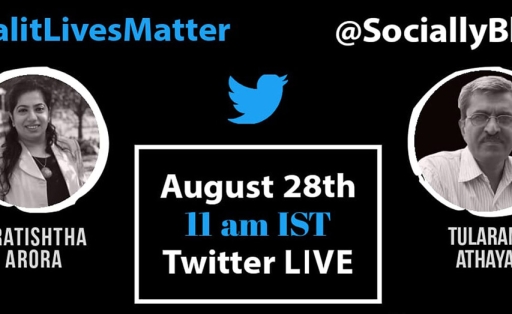
On 28th August 2020, Tularam Athya, from Madhya Pradesh spoke with Pratishtha Arora from Social & Media Matters. He is known for working on the caste system at the grassroots. He is a social activist and national head of Dalit Solidarity Committee. Tularam recently started Bahujan Samvaad an online initiative during lockdown. On the 11th Episode of Dalit Lives Matter, he shared insights of his work with team SMM.
As an opening note Pratishtha shared the work SMM has being doing to eradicate caste discrimination in the online spaces and shared, “Social Media Matters (SMM) is working on casteism for a long time as it is mostly known for online safety initiatives. The casteist slurs online are being examined and observed by SMM team in order to find solutions to end it through artificial intelligence. Online space is turning into hate speeches related to caste based remarks these days. SMM has done pan India research to know and understand about these online abusers. We have also collected several words through our sample survey on their meaning in different parts of the country.”
On being asked about experiences on working on caste system and origin of his work, Tularam said, “I started this work 25 years ago. The main reason was the caste based discrimination in society especially when it comes to the Dalit community. I had witnessed the discriminatory practices in my village since childhood. During any social function Dalits were made to sit separately and were often served food near cowshed. There was also a separate allotted space for Dalits near the well. These experiences made me realize each one of us must get equal opportunities in society. Even after 70 years of independence there’s not much change in villages.”
When questioned about the impact of his on ground and offline initiatives on people’s mindset in terms of caste system, Tularam shared, “Wherever we’ve worked at a societal level there have been some changes, untouchability especially has been reduced to some extent. But the villages where there’s no effort towards social reformation, we do not see any such changes.” He further added, “The radicalization and Dalit oppression has seen a rise since 2014.”
When asked about using social media, Tularam said, “I mostly use Facebook and WhatsApp as medium of online connectivity. I’ve a Twitter account but I rarely use it. I’m frequently active on Facebook and also have formed many WhatsApp groups to disseminate valuable information”
Reality of the online and offline world in terms of caste system, Tularam opined, “There’s a huge difference between field work and online work. We can’t do online work with those living in villages.” He further added, “As far as misuse of social media is concerned, it’s the same as on ground atrocities. Through social media abusive language is often used to exploit Dalit community and its women.”
Pratishtha said, “We collaborated with some people from Tamil Nadu, Kerala and Karnataka, who told us about some words that we included in our list. In the context of the caste system often such words or their reference is used in the online medium.”
On being asked about any particular caste based words used in his native, Madhya Pradesh, Tularam said, “Some caste related words are used often to insult people. They just want to convey that you belong to a lower caste.”
When Pratishtha questioned youth participation in creating awareness about caste based realities, Tularam said, “Today’s youth is educated and sensible. The yesteryear’s generation wasn’t much educated.” He further added, “The youth can create WhatsApp groups for spreading awareness. Most importantly I believe if the youth works at ground level to create awareness it’s quite impactful. Since, these are the COVID – 19 times, so we should try to use social media effectively.”
On awareness and activism during COVID times, Tularam said, “We’ve been using social media to convey our ideas and connect with people for creating awareness. WhatsApp is used to connect with usually senior citizens. We’ve been conducting ‘Bahujan Samaj,’ live sessions at a national level on Facebook. Our sessions have included eminent intellectuals like Professor Anand Kumar. We spoke on many burning issues in our society.”
About inspiring young activists to use social media for social change, Tularam said, “I appeal to all our friends and intellectuals to use social media as much as possible to convey our ideas.” He further added, “The oppressed and downtrodden sections need to use social media to raise their voices. We can communicate our thoughts and issues to society in a better way through Facebook, Twitter and WhatsApp.”
While concluding Tularam conveyed Dr. B R Ambedker’s message to people on caste system. He stated, “If we have to make a casteless society then our youth should move ahead in the same direction. We need to encourage inter – caste marriages as Babasaheb had rightly said. Then only the caste system could be abolished. Unless we break these caste based barriers this discrimination won’t end. Our youth will have to make strong efforts.”
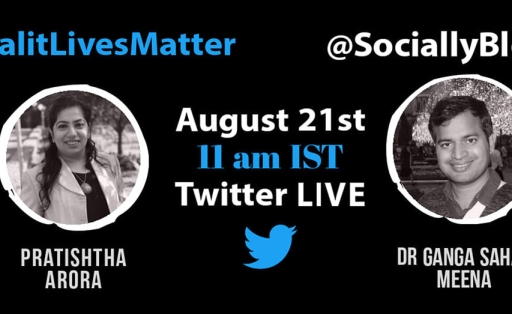
On 21st August, Ms Pratishtha Arora, engaged in a Twitter Live session with Prof. Ganga Sahay Meena, an associate professor from Jawaharlal Nehru University, Delhi.
The conversation began with Ms Pratishtha introducing our esteemed guest, and apprised the viewers regarding the various prizes and awards that he has been honoured with over the past few years for his various academic achievements, and work on caste issues. She then proceeded to ask Mr Meena, about his journey into his study of caste. He spoke of his various inspirations and how coming to JNU exposed him to various kinds of literature, and how he understood the need to ask relevant questions regarding systemic discrimination on the basis of caste.
He quotes Om Prakash Valmiki's autobiography "Jhoothan" in discussing the significant ways in which the development of caste consciousness occurs. As per the book, the first step was to obtain education and break free from the expected jobs which are associated with different castes. The second step was when one moves out of villages, and come to the city in search for better opportunities, where he says there is a definite decrease in the amount of caste discrimination.
Prof. Ganga Sahay Meena, talks about a relevant point wherein he says that like patriarchy is followed by men and women alike, similarly, caste discrimination is followed by all castes, due to centuries of conditioning.
A viewer raised a pertinent question is to "Who is a Dalit?". Prof. Ganga Sahay Meena, said that Dalit is a sociological term, used to refer to the group classified as "Scheduled Castes" in the Constitution of India.
He talks about how caste hierarchy is still prevalent in the villages of India. Inter-caste marriages are largely prohibited and discouraged, and in this light, he speaks of the atrocities towards Dalit women. In the cities, at the outset it seems that there is no caste hierarchy. However, this is not true. He discusses how in the matrimonial columns of newspapers, the concept of caste is paramount. He then speaks of how there is very little Dalit representation in various professional spheres, and says that this is because of the prevalence of caste discrimination, albeit in a hidden form. He discusses the notion of "cultural" and "social" capital, in addition to a financial capital, which aids in the upward mobility of people in society.
In terms of online spaces, he brings up how caste hierarchy is making its way on various social media platforms as well. He cites examples of various kinds of abusive terminology which targets Dalits, and how many times there is discrimination against Dalit accounts.
When asked about ways in which online spaces can be used to end caste based discrimination, he says that while there is no "one size fits all" approach, there are certain ways to work towards it. One is to encourage inter-caste marriage. He then discusses how there is a lot of resentment towards Dalits among upper caste Indians, due to reservation. He feels that this should be dealt with, by educating upper castes on how Dalits have not been given educational and financial opportunities for centuries and reservation is a way to emancipate them to some degree.
He raises a pertinent issue of how there has to be dialogue among various castes, socio-economic classes, and genders, to understand the presence of discrimination, and work towards a progressive society. He also speaks of how there is a serious dearth of discussion on gender issues, and caste issues in schools and colleges, which often results in perpetuation of discrimination in society.
In terms of the responsibility of social media platforms towards ensure caste equality, Prof. Ganga Sahay Meena speaks of how the advisory boards of these organizations must have adequate representation from across various socio-economic sections. This will ensure that more responsible decisions regarding caste and gender issues are taken.
In conclusion, Prof Meena speaks of using social media, to convey one's perspectives and ideas, in a respectful manner. This, he feels will definitely aid the process of social change, and provide a democratic space for exchange of ideas.